The Other 50%
How the participant's inner state determines whether an experience creates growth
13 min read · September 2026

Co-founder, Sidecar · Program Director, Kaospilot Experience Design
In April 1957, Marcel Duchamp stood up at a convention of the American Federation of Arts in Houston and said something that made the art world uncomfortable.
The artist, he argued, does not complete the work of art. The viewer does.
His argument was simple but radical. When an artist paints, they make a series of decisions: what to include, what to omit, how to direct the eye, what feeling to reach for. But those decisions only become meaningful in contact with a viewer who brings their own imagination, memory, and emotional history to the canvas. The artwork is not the object on the wall. It is the event that happens when the object meets the beholder. Without the beholder, there is no art, only paint.[1]
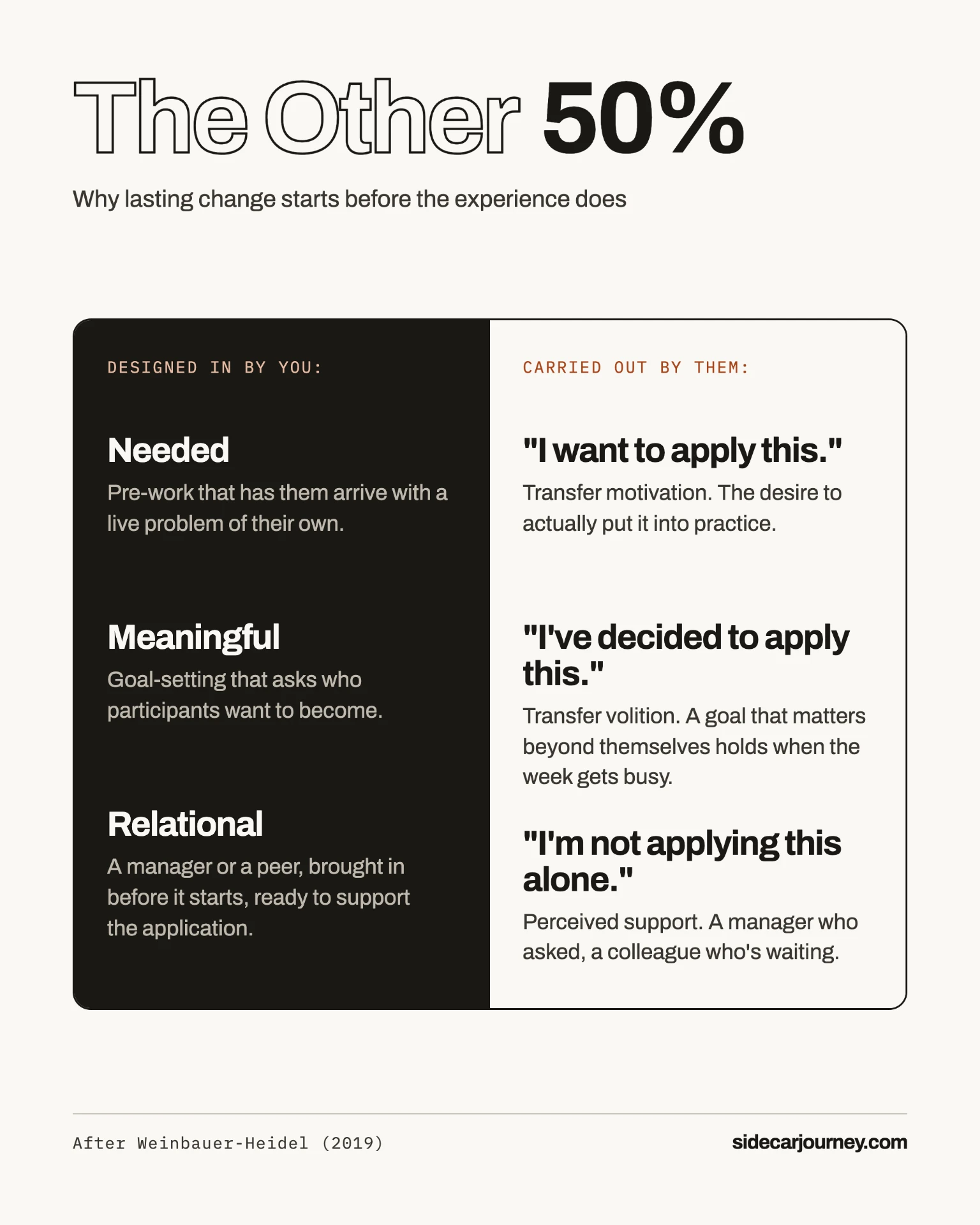
Duchamp did not put a number on it. Others have. The neuroscientist Lisa Feldman Barrett, writing about what art historians call the beholder's share, sets the split at half: the artist completes 50% of the work, and the other 50% happens in the viewer's brain.[2]
The same split runs through every learning experience. A designer controls the content, the sequence, the room, the facilitation, the invitation. The participant creates the other half: what transfer researchers call transfer motivation, self-efficacy, and volition. Whether they arrive wanting to change, believing they can, and intending to. According to Weinbauer-Heidel's synthesis of over a century of transfer science, these three factors predict application more reliably than anything in the room.[3] They are not personality traits. They are conditions. And conditions can be designed.
The transfer gap
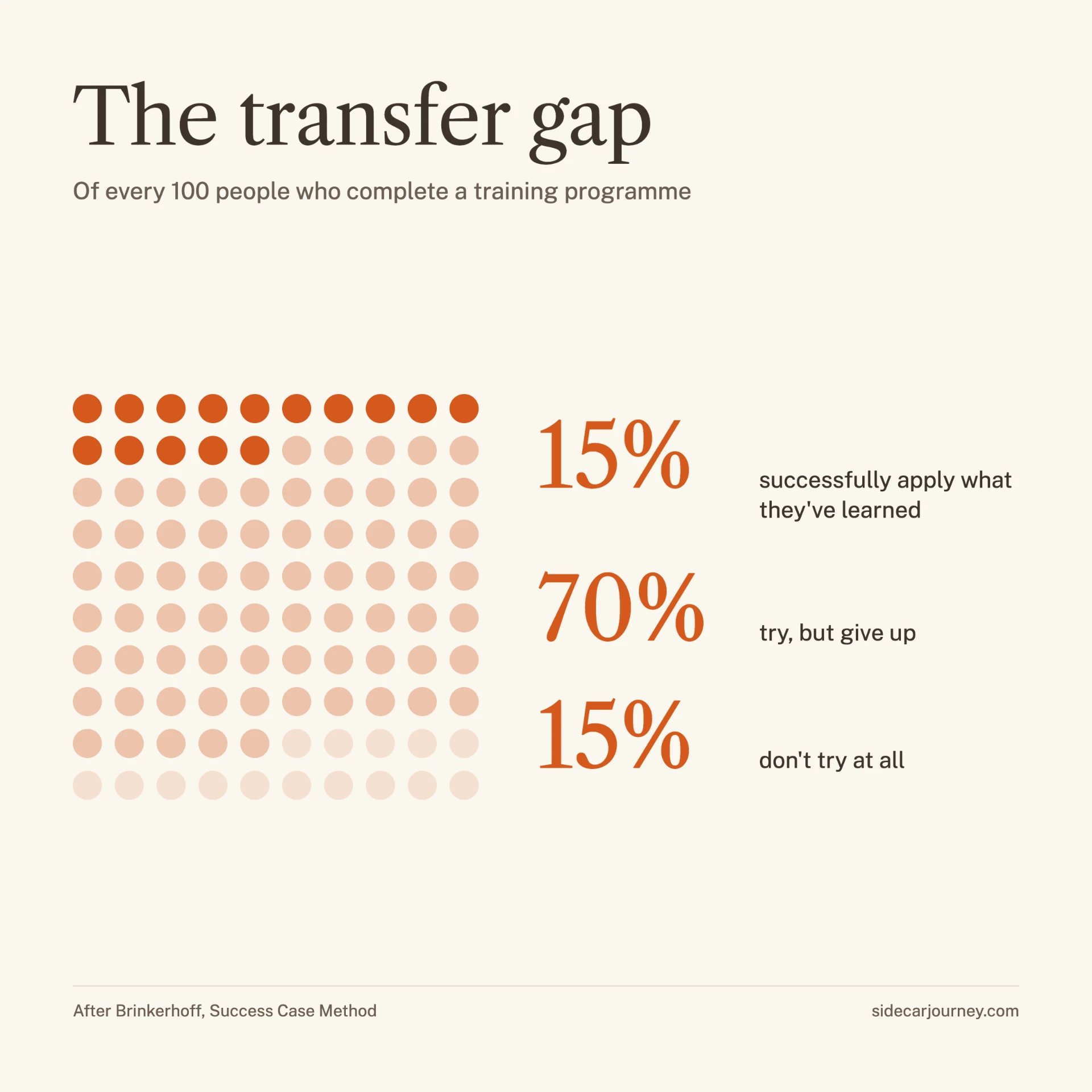
Professor Robert Brinkerhoff, one of the most rigorous researchers in learning effectiveness, tracked what actually happens after people complete training programmes. His findings are arresting: around 15% of participants successfully apply what they have learned. Around 70% make some attempt but give up. The remaining 15% do not try at all. This comes from Brinkerhoff's decades of evaluating real training programmes using his Success Case Method. It's a practitioner estimate, not a single lab study, and the exact percentages are debated, but the shape of the finding holds up across the research: most people try and fail, not for lack of intent but for lack of support after the event.[4]
The field's response has been to improve the training: gamify the content, make learning more 'fun', or go the other way and drill down to the measurable results. These efforts are not wasted. But they address only half of the equation that designers already control. The other 50%, the participant's inner state, their motivation and readiness to act, goes almost entirely unaddressed.
The best way to sustain a transformation is to get them ready for it in advance.
This is the first of two papers making the case for how. This paper focuses on preparation: what happens before an experience begins, and why deliberately designing that flow can shift the conditions for lasting change. The second paper will address the whole Transfer Arc and a structured integration methodology for turning the spark of an experience into something that endures.
What the research actually says
Dr. Ina Weinbauer-Heidel's research distilled over a century of transfer science into 12 factors that aim to reliably predict whether learning gets applied. They fall into three categories: the trainee, the training design, and the organisational environment.
The most determining predictors are all internal to the learner: transfer motivation, self-efficacy (the belief that one can actually apply what one has learned), and transfer volition (the active intention to do so). There is, however, relatively little research specifically about how to shift these inner conditions.
The strongest determinants of whether an experience produces change are not what happens during the experience. It is the participant's perspective before it begins, and in the environment they return to afterward.
Transfer fails at two distinct moments. The first is before the programme: participants arrive without clear intention, without a real problem to solve, without the motivation and self-efficacy that research identifies as the strongest predictors of application. The second failure happens after the programme ends. With no structured integration, no reflection cycles, no accountability, the insights that felt urgent in the room gradually lose to the gravity of daily routine.
The Encapsulation Model for Transformation
A parallel body of thinking arrives at the same conclusion from a different direction entirely. In his long-awaited book The Transformation Economy (2026), B. Joseph Pine II, the originator of the experience economy, introduces what he calls The Encapsulation Model. His argument: lasting transformation does not come from an experience itself, but from what comes before and after it. The model describes three phases:
Preparation, which opens people to change before an experience begins;
Reflection, which helps them make meaning in the aftermath;
Integration, the sustained process of turning insight into new behaviour.
Drawing on psychologist Dr. Suzy Ross, Pine notes that the integration phase alone often takes considerably longer than the experience itself.[6] Pine calls it transformation; Weinbauer-Heidel calls it learning transfer. The conclusion is the same: the experience is a spark that, if not fed, will go out and leave nothing changed.
By far the most important element of a transformative experience is the traveller's mindset before, during, and after their adventures.
Designing for the other 50%
An experience is not something a designer creates and places in someone's head. Experience is always constructed by the learner. Neuroscience is unambiguous on this point: we do not receive reality, we are co-creators in building it.[8] Which means that taking steps to increase participants' motivation, agency, and will to apply what they learn is not a nice-to-have. That is the whole point.
Nick Shackleton-Jones, learning researcher and author of How People Learn, puts it plainly: adults do not learn from content, they learn from caring.[9] If a participant does not genuinely care about the subject, if it does not connect to something live and consequential in their work or life, even excellent content will pass through them like water through sand.
Malcolm Knowles, the foundational theorist of adult learning, identified the same principle decades earlier: adults need the why before the what.[10] The role of preparation is to guide the participant in uncovering their why, before they enter the room.
Priya Parker, in The Art of Gathering, argues that 90% of what makes a gathering successful happens before it begins.[11] Her focus is on the intentionality of the host: the clarity of purpose, the curation of the group, the meaning embedded in the invitation itself. These are not logistics. They are acts of design that shape the weight and velocity of the motivation the participant is bringing into the room.
Designing the pre and post: the rosy view effect
There is another reason to design what happens before and after an experience, and it has less to do with transfer than with how the experience itself will be remembered. In a landmark study tracking participants through three meaningful events, including a trip to Europe and a three-week bicycle journey in California, Mitchell and colleagues found a consistent and somewhat counterintuitive pattern: anticipation before the event was more positive than the lived experience, the experience itself was often dampened by distraction and small disappointments, but recollections afterward were warmer than the experience had actually been. They called it the rosy view.[12]
What this means for designers is significant. A well-prepared participant arrives with expectation that is grounded and purposeful rather than merely optimistic, which narrows the gap between anticipation and reality. A participant who is supported in reflecting afterward is more likely to consolidate the positive meaning of what they encountered, rather than let daily friction quietly erode it. Designing the before and after is not only how you improve transfer. It is how you shape what the participant carries away, and whether they come back.
Where preparation time actually goes
An informal LinkedIn poll of learning and development professionals asked where they spend most of their preparation time before a session.[13] The results were striking: 82% reported spending the majority of their preparation time on the experience itself, the content, flow, materials, and activities. Just 7% reported spending the majority of their time preparing the participants.
This allocation reflects a deeply embedded assumption: that the facilitator's job is to design a great experience, and the participant's job is to show up and engage. The transfer research suggests this assumption is exactly backwards. The experience is the middle. What happens before and after it is where transfer is won or lost.
Genuine preparation operates at a different level than pre-work or reading assignments. Its goal is to shift the participant's inner state before the experience begins: to increase their intrinsic motivation, their sense of personal relevance, and their readiness to act on what they encounter. The three highest-impact levers for transfer are all shapeable before training begins. But only if someone intentionally shapes them.
Four preparation practices with evidence behind them
The following practices are grounded in research on transfer, psychology, and experience design. They are not a formula. Context, audience, and format will shape how each is applied. But each addresses one or more of the high-impact transfer levers the research identifies.
1. Needed: Orient around what is important to the participant
Ask every participant, before the programme begins, to identify a live challenge from their own work: something unresolved, something they need to act on in the coming months. Not a hypothetical. Something that keeps them up at night.
This single step activates two of Weinbauer-Heidel's top transfer predictors simultaneously: transfer motivation and content relevance. Without a real problem to anchor to, even excellent content has nowhere to land. When learning connects to something the participant genuinely owns, the question of application largely answers itself. The facilitator's role shifts from "how do I make this relevant?" to "how do I help them think differently about the problem they already care about?"
Before your next session: can every participant name the real-world problem they are bringing into the room?
2. Meaningful: Support developmental learning goals
A meaningful learning goal is not "I want to improve my leadership." It is specific, emotionally engaging, and personally owned by the learner.
Weinbauer-Heidel identifies meaningful action planning as one of the highest-yield quick-win levers available to practitioners. But the research points to something more nuanced than skills acquisition. Adults distinguish between learning that develops their capabilities, and learning that develops them as people: not just what they can do, but how they see and interpret the world. Robert Kegan's constructive-developmental research documents this across decades: the most durable learning reorganises how a person makes sense of their experience, not merely what they can execute.[14] Horizontal development adds skills. Vertical development changes the person. Both matter, but it is the second that participants describe when they reflect on an experience that genuinely changed them.
Before your next session: are participants' goals connected to something they personally care about, or are they worded in the language of job descriptions?
3. Relational: Engage people to support the participant
Applying new behaviour at work is vulnerable. It requires doing something unfamiliar in a very familiar environment, often without immediate results. And that familiar environment, colleagues, norms, pressures, habits, has not changed. Only the participant has, a little, if the programme was any good.
This is the moment where most transfer dies. Not because the insight wasn't real, but because no one built the social infrastructure to hold it. Brinkerhoff and Montesino's research is direct: manager support before and after training is one of the strongest predictors of transfer, comparable in effect to the quality of the training itself. Their recommendation was to build structured trainer-manager-trainee partnerships across all three phases.[15] That structure is rarely built. Before the programme begins, ask participants to brief their manager on what they hope to apply, and to identify one colleague who can hold them accountable afterward. That scaffolding, built before anyone enters the room, is what gives insights the structural support to survive contact with real life.
Before your next session: does anyone outside the room know what the participant is hoping to change, and have they agreed to support it?
4. Designed: Implementation is part of the design
There is a quiet assumption built into most programme design: the learning happens in the session, and participants go apply it afterward. The session is the product. What comes after is up to them.
Brinkerhoff's research exposes how costly this assumption is. The 70% who try to apply what they have learned and give up are not failing because the session was poor. They are failing because no one designed for the moment after the door closed. No structure for application. No prompt to reflect. No accountability. The insight was real. The conditions to hold it were not there. Treating implementation as part of the design brief, rather than a follow-up activity bolted on afterward, means mapping each core concept to a specific application task: concrete, time-bound, and small enough to actually attempt. Not "apply the model." Something closer to: "Use this in one conversation before the end of next week and bring back what happened."
Before your next session: does your programme design include specific, time-bound application tasks, and a moment to hear what participants learned from attempting them?
Completing the work
In 1957, Duchamp's argument was about art. But the principle generalises further than he probably intended.
Any experience, a programme, a retreat, a workshop, a conversation, is only ever half-finished when it leaves the designer's hands. The other half is completed by the person who walks into it: their readiness, their intention, the live problem they are carrying, the support waiting for them on the other side. Without that half, the most beautifully designed experience is still just paint on a wall.
What the Brinkerhoff data tells us is that the 70% who try and give up are failing because the conditions for sustained application were never built. No concrete intention. No specific plan. No one holding them accountable. No structure for reflecting on what is working.
Preparation addresses the foundation: ensuring participants arrive with motivation, a live problem, and a genuine readiness to be changed by what they encounter. That alone shifts the odds meaningfully.
But preparation is not the complete answer. Just as a painting is only completed by the beholder, the beholder still has to do something with what the experience stirred in them. The question of what happens after the door closes, how insights get worked, tested, and integrated into new patterns of behaviour, is where most programmes fall silent. It is where the 70% are lost.
That is what the second paper in this series addresses: a structured integration methodology for closing the gap between insight and practice, and making the 15% the rule rather than the exception.
For now, the place to start is here, before your next programme. Ask not whether your content is ready. Ask whether your participants are.
Make your experiences stick
Sign up for an occasional letter and to be the first to know when we release new research.
Works cited
1. Marcel Duchamp, “The Creative Act”, talk delivered at the Convention of the American Federation of Arts, Houston, April 1957. Reprinted in ARTnews 56(4), Summer 1957, 28–29. Duchamp argues that the creative act is not performed by the artist alone and that the spectator adds their contribution by deciphering and interpreting the work. He does not quantify either share. ↑
2. Lisa Feldman Barrett, Seven and a Half Lessons About the Brain, Houghton Mifflin Harcourt, 2020, and its published notes, where Barrett glosses Duchamp as putting the artist’s share at half and the viewer’s at the remaining 50 per cent. The figure is hers, not Duchamp’s. The underlying idea, the beholder’s share, is named in E. H. Gombrich, Art and Illusion, Phaidon, 1960, and traced to Alois Riegl. sevenandahalflessons.com ↑
3. Ina Weinbauer-Heidel with Masha Ibeschitz-Manderbach, What Makes Training Really Work: 12 Levers of Transfer Effectiveness, tredition, 2019. The twelve levers fall into three groups: the trainee, the training design, and the organisational environment. The transfer literature it synthesises runs back to Thorndike and Woodworth, 1901. ↑
4. The 15 / 70 / 15 split is Robert O. Brinkerhoff’s practitioner estimate from decades of Success Case Method evaluations, not a single published study; see The Success Case Method, Berrett-Koehler, 2003. For observed figures, Alan M. Saks and Monica Belcourt (2006), Human Resource Management 45(4), 629–648, report applied training falling from 62% immediately after a course to 44% at six months and 34% at one year, on training professionals’ estimates. doi.org/10.1002/hrm.20135 ↑
5. B. Joseph Pine II, The Transformation Economy: Guiding Customers to Achieve Their Aspirations, Harvard Business Review Press, 2026. ↑
6. Pine, The Transformation Economy, 2026, on the Encapsulation Model: preparation beforehand, reflection afterward, and integration on an ongoing basis. The point that integration alone runs longer than the experience draws on the work of Dr Suzy Ross. ↑
7. Michael Bennett, Transformational Travel Council. ↑
8. Lisa Feldman Barrett, How Emotions Are Made: The Secret Life of the Brain, Houghton Mifflin Harcourt, 2017. ↑
9. Nick Shackleton-Jones, How People Learn: Designing Education and Training That Works to Improve Performance, Kogan Page, 2019. ↑
10. Malcolm S. Knowles, The Adult Learner: A Neglected Species, Gulf Publishing, 1973. ↑
11. Priya Parker, The Art of Gathering: How We Meet and Why It Matters, Riverhead Books, 2018. ↑
12. Terence R. Mitchell, Leigh Thompson, Erika Peterson and Randy Cronk, “Temporal Adjustments in the Evaluation of Events: The ‘Rosy View’”, Journal of Experimental Social Psychology 33(4), 1997, 421–448. doi.org/10.1006/jesp.1997.1333 ↑
13. Andy Brattbakk, informal LinkedIn poll of learning and development professionals. ↑
14. Robert Kegan, In Over Our Heads: The Mental Demands of Modern Life, Harvard University Press, 1994. ↑
15. Robert O. Brinkerhoff and M. U. Montesino, “Partnerships for Training Transfer: Lessons from a Corporate Study”, Human Resource Development Quarterly 6(3), 1995, 263–274. doi.org/10.1002/hrdq.3920060305 ↑