The 5E Experience Design Model
A step-by-step guide to designing meaningful experiences
Andy Sontag · First published 26 January 2018
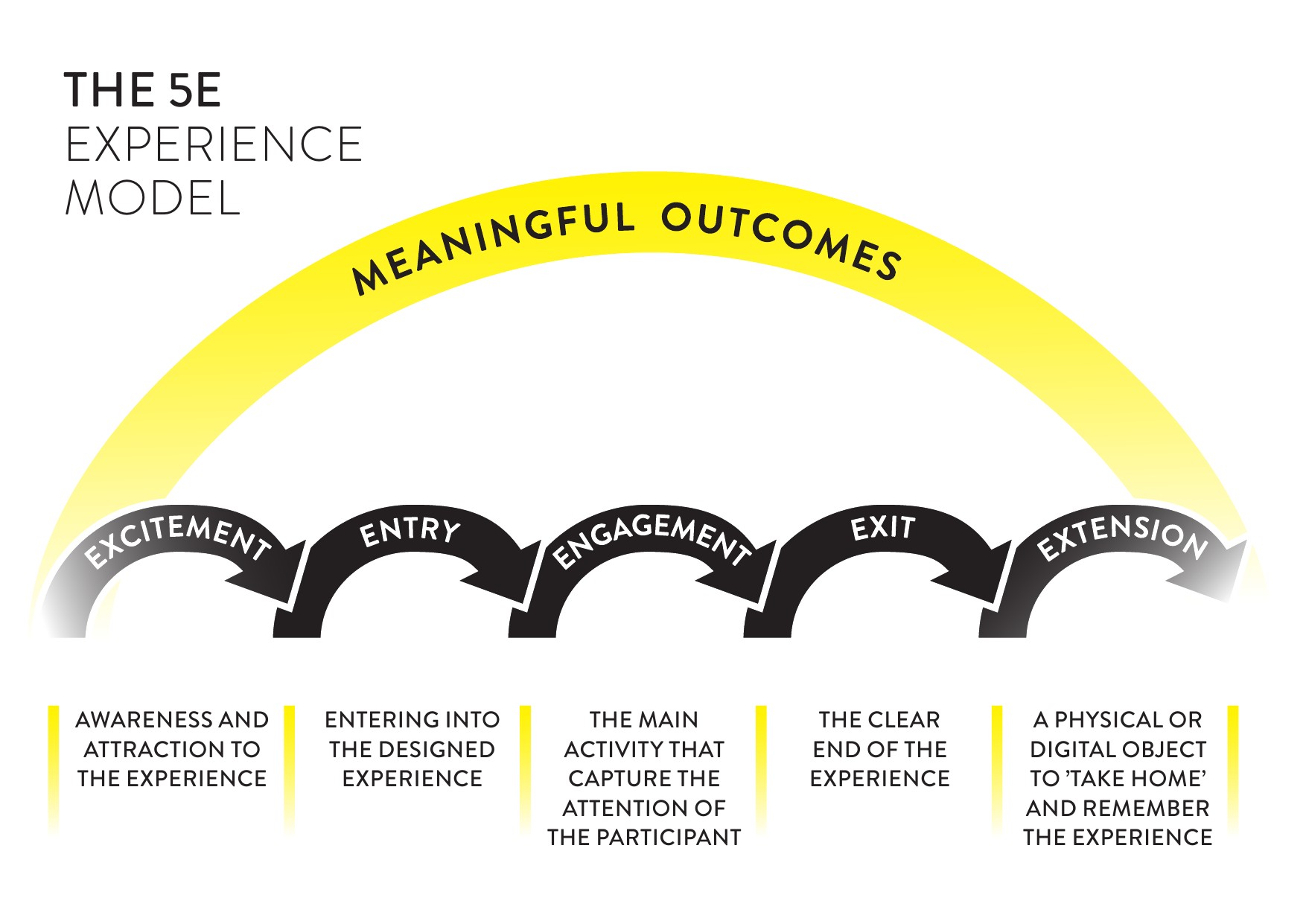
- Excitement: Awareness and attraction to the experience
- Entry: Entering into the designed experience
- Engagement: The ‘main course’ of the experience
- Exit: The clear end of the experience
- Extension: A physical or digital object to ‘take home’ and remember the experience
This article will take you step-by-step through the 5E model, an Experience Design framework for crafting impactful services, events, or learning experiences. It will help you design and orchestrate experiences that deliver meaningful outcomes.
The 5E model is really useful to help you align a team, access collective creativity, and employ distributive leadership models that enable collaboration and design in complexity. It is an integrative model that can add coherence, elegance and excitement to your service or experience. It is simply a framework for building holistic and meaningful experiences.
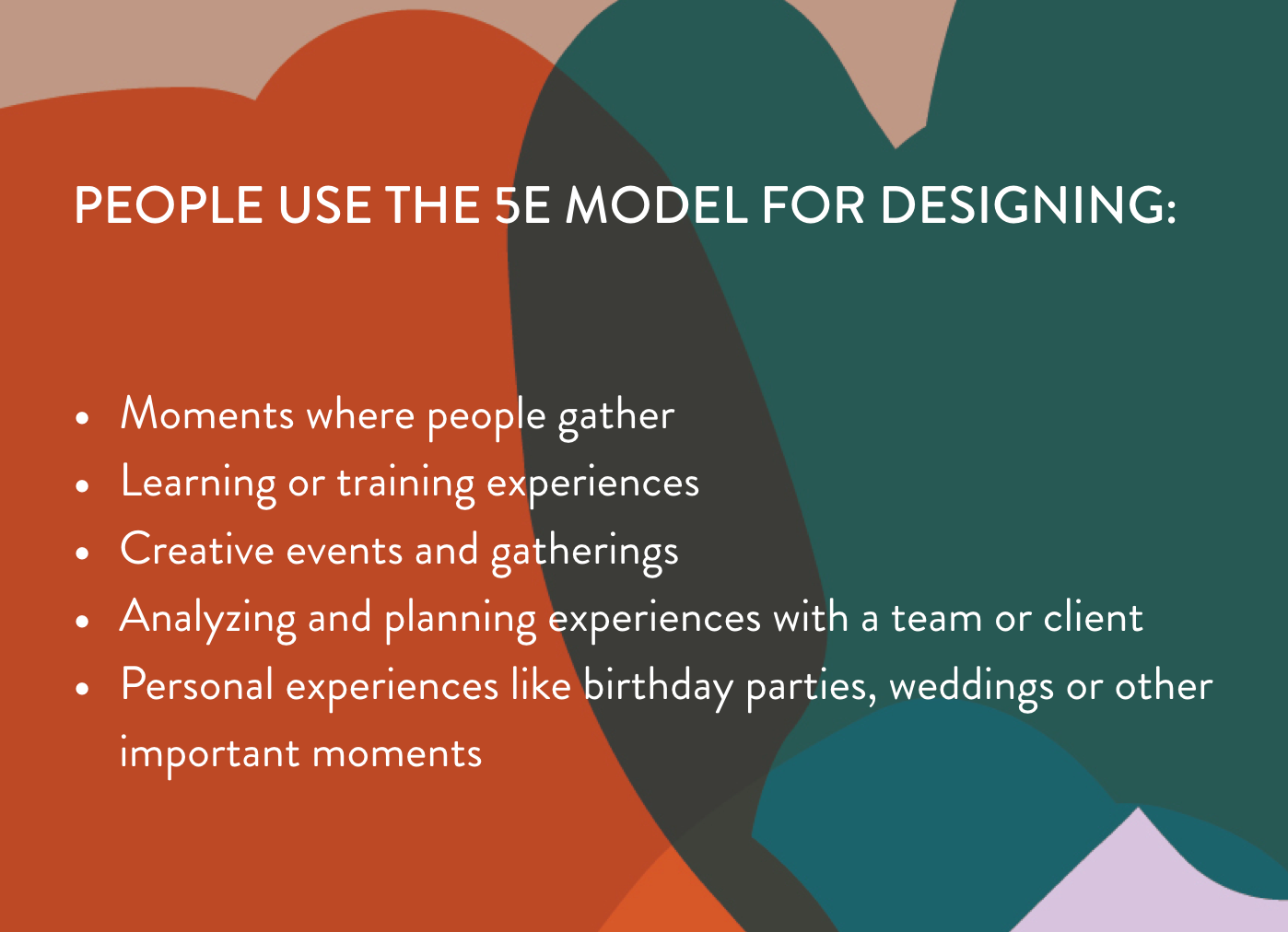
Image from the talented Rasmus Stride
We’ve put this model through extensive use. We have learned from working with executives from Volkswagen in Germany, with AR artists in Brazil, with Human Resource directors from Spain, and used the mindsets here to initiate the global social movement 100 in 1 Day. The 5E model builds upon the amazing work of Larry Keeley in 1994 and Nathan Shedroff’s work with Core Meanings.
We are so excited to share what we’ve learned with you, in 3 simple steps for using this thoroughly versatile tool:
- Define the Meaningful Outcomes
- Define the Emotional Journey
- Design What Happens, and learn through action
So, let’s begin at the beginning, the top of the model, which is where we’ll find the first step:
1. Define the Meaningful Outcomes
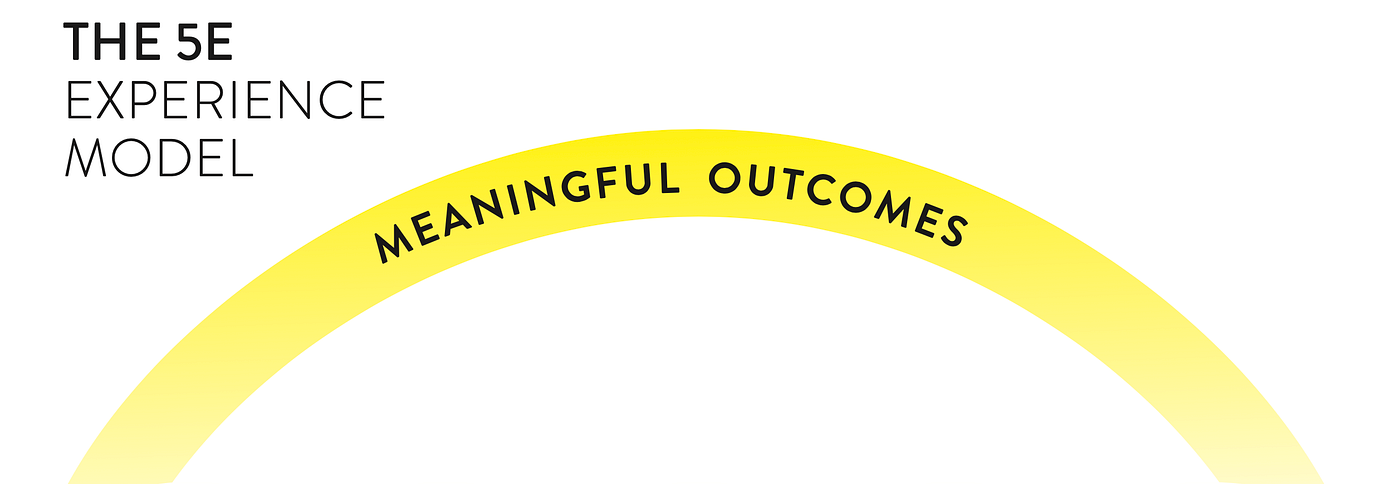
Step 1: Define the top 3 Meaningful Outcomes you wish to create.
The first step in designing the experience is to define the Meaningful Outcomes you wish your experience to create.
People seek meaning and experiences that positively enhance their lives. The 5E model has 5 phases, the “E’s”, which we’ll dive deeper into below. To start, we must have the end in mind: to create meaningful outcomes for our users.
“Today, 8 in 10 consumers say purpose is at least as important to them as Customer Experience.”
Accenture, Growth: It Comes Down to Experience (2022)
Define the top 3 Meaningful Outcomes you wish to create
Start designing the experience by selecting the Meaningful Outcomes you wish your experience to create and describing them.
To define the Meaningful Outcomes of your experience is to define the source of the positive impact you aim to create. It is the sun that gives life and energy to you, your team and ultimately the people you are designing for. For a summit to gather designers in Holland, the meaningful outcome was: Community. We designed an event that created this outcome through activating participants to be playful, creating strong culture frames for positive relationships, and focusing our activities on serving a bigger purpose together.
Focusing on creating Meaningful Outcomes enables you and your customers to take actions that support a more just and sustainable world. An incredible resource to check if you are creating Meaningful Outcomes is to work with the SDGs.
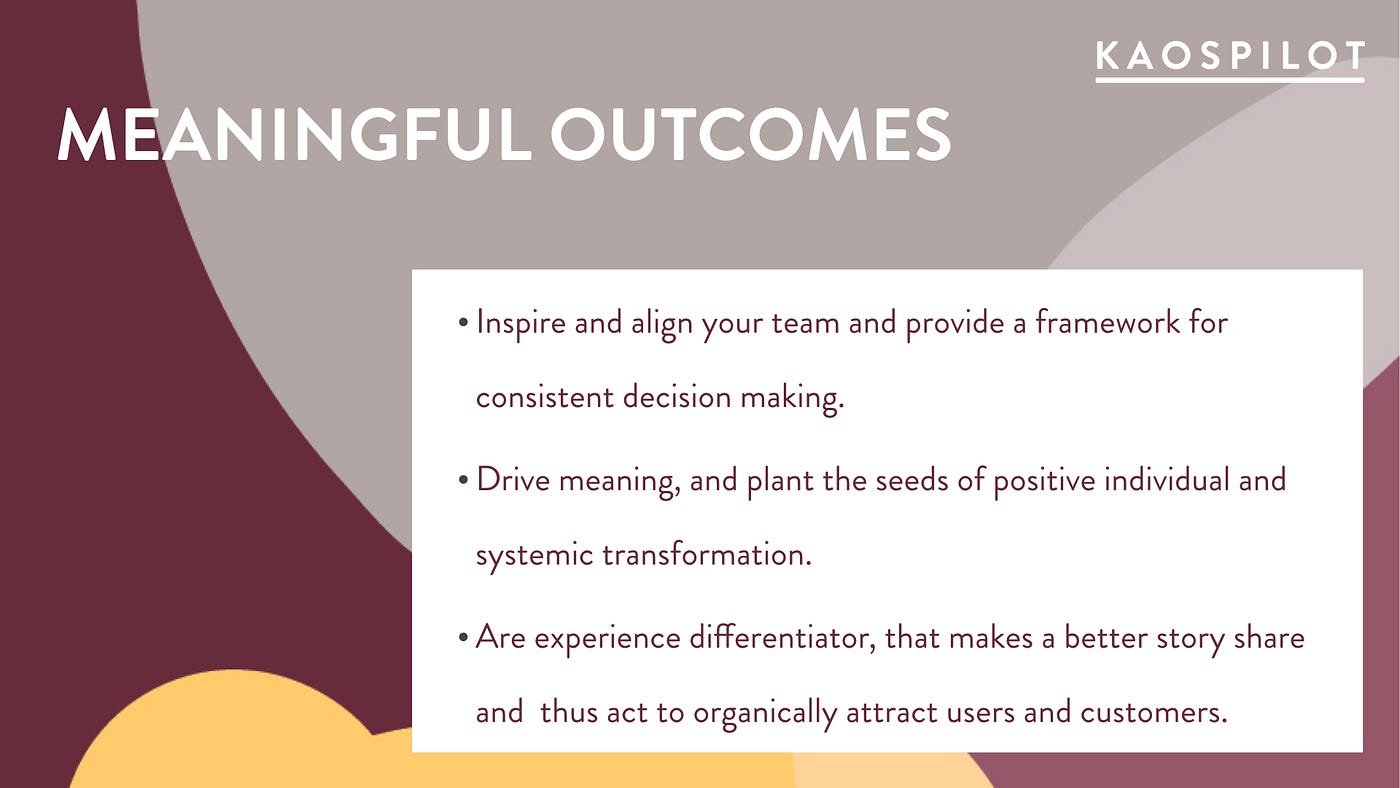
Thoughts on Meaningful Outcome inspired by Alberto Barreiro. Image from the talented Rasmus Stride
Meaning is Personal
The personalisation of the experience around what is meaningful to the people you serve is an essential aspect of creating meaningful outcomes. This personalisation can take the form of doing individual ‘caring’ actions, like handwriting cards for each participant, or of allowing participants to personalise their own experience, for example by giving them choices, time to reflect and be in relationship. Always try to learn about those you are designing for during the design process and as the experience is delivered. What is important is to approach your users with curiosity and humbleness, and create as many contexts as possible where you listen to what is meaningful to them throughout the design and delivery process.
Science Shows
Luckily for us there is a team of Nobel Prize winners, philosophers and researchers, such as Martin Seligman and Daniel Kahneman, that have devoted their lives to answering the question: What makes a human life meaningful? So, though it is important to personalise, we can also create meaningful experiences by including the elements of experience below. To summarise these sources, adding these elements of experience has been empirically shown to support the creation of more meaningful outcomes:
Experiences that support Meaningful Outcomes:
💃🏻 Flow: Fluid full presence in an experience
🧘🏾♀️ Mindfulness: Experiencing the ability to control one’s attention
🏃🏽 Play: A state of exploration without an extrinsic purpose
☀️ Purpose: Experiencing being part of a cause that is bigger than oneself
👩🏾🤝👩🏼 Positive Relationships: Generative ways of interacting
🪁 Autonomy: Freedom/intrinsic motivation
☺️ Positive Emotions: Feeling gooooood
🤓 Practitioner tip: To dive deeper, we recommend the books The Age of Experiences: Harnessing Happiness to Build a New Economy and Character Strengths Interventions: A Field Guide for Practitioners, which summarise and provide exercises to bring the new science of happiness to your clients, building on the research from the VIA Institute.
If you would like to dive even deeper into these topics, check out our learning immersions.
For the summit to gather designers in Holland, where the meaningful outcome was Community, some experiences we designed that were crucial to supporting this Meaningful Outcome were:
🏃🏽 Play: activating participants to be playful in the beginning of the first day, to set the tone for connection.
👩🏾🤝👩🏼 Positive Relationships: Spending time each day to build a strong culture and frames for positive relationships.
☀️ Purpose: Focusing our activities on serving a bigger purpose, and co-creating this together.
“The meaningful outcomes come to life through each of the 5Es, building synergy and momentum.”
Carola Verschoor
Below is a visual walk-through of the 5 phases. Each is important and all are meaningful together:
Excitement
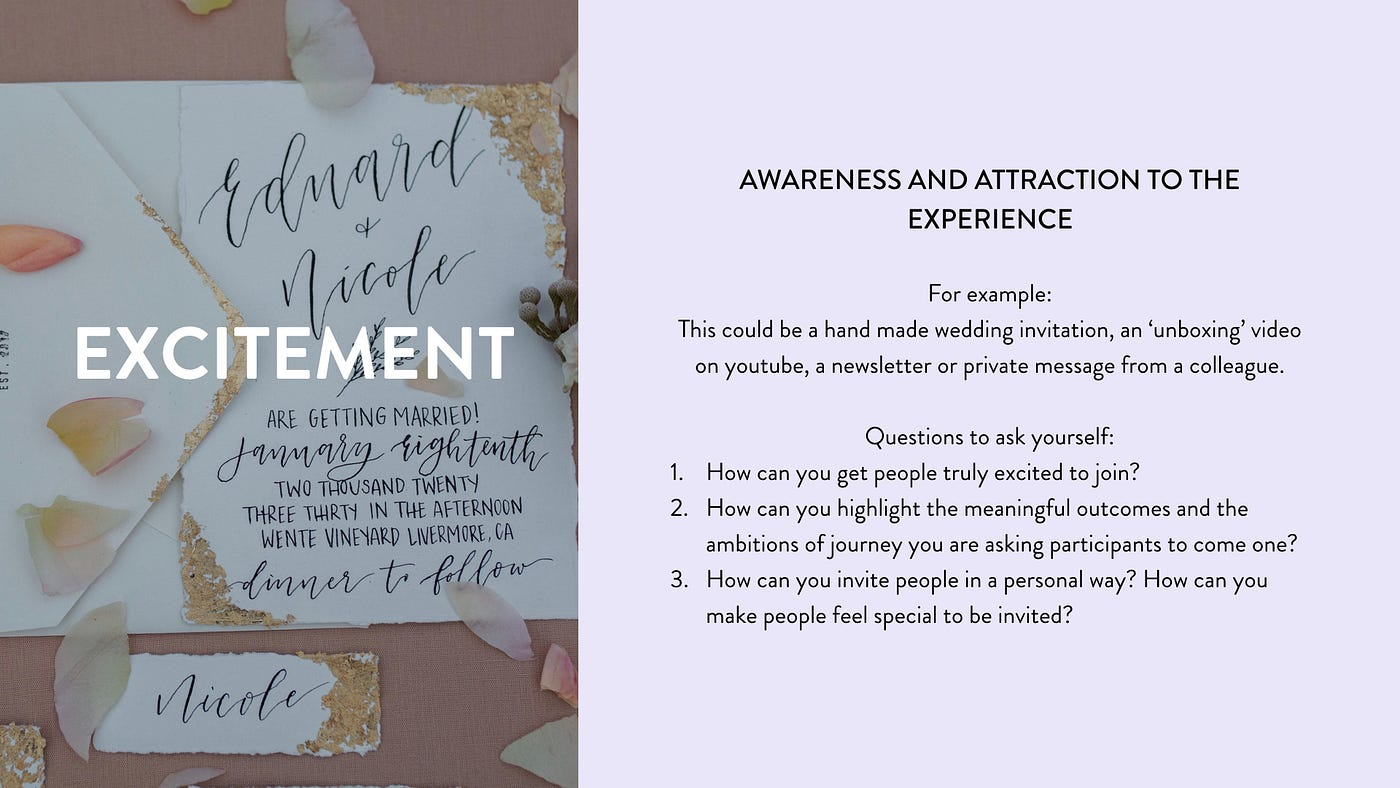
Awareness and attraction to the experience.
For example: This could be a handmade wedding invitation, an ‘unboxing’ video on YouTube, a newsletter or a private message from a colleague.
Questions to ask yourself:
- How can you get people truly excited to join?
- How can you highlight the meaningful outcomes and the ambitions of the journey you are asking participants to come on?
- How can you invite people in a personal way? How can you make people feel special to be invited?
Entry
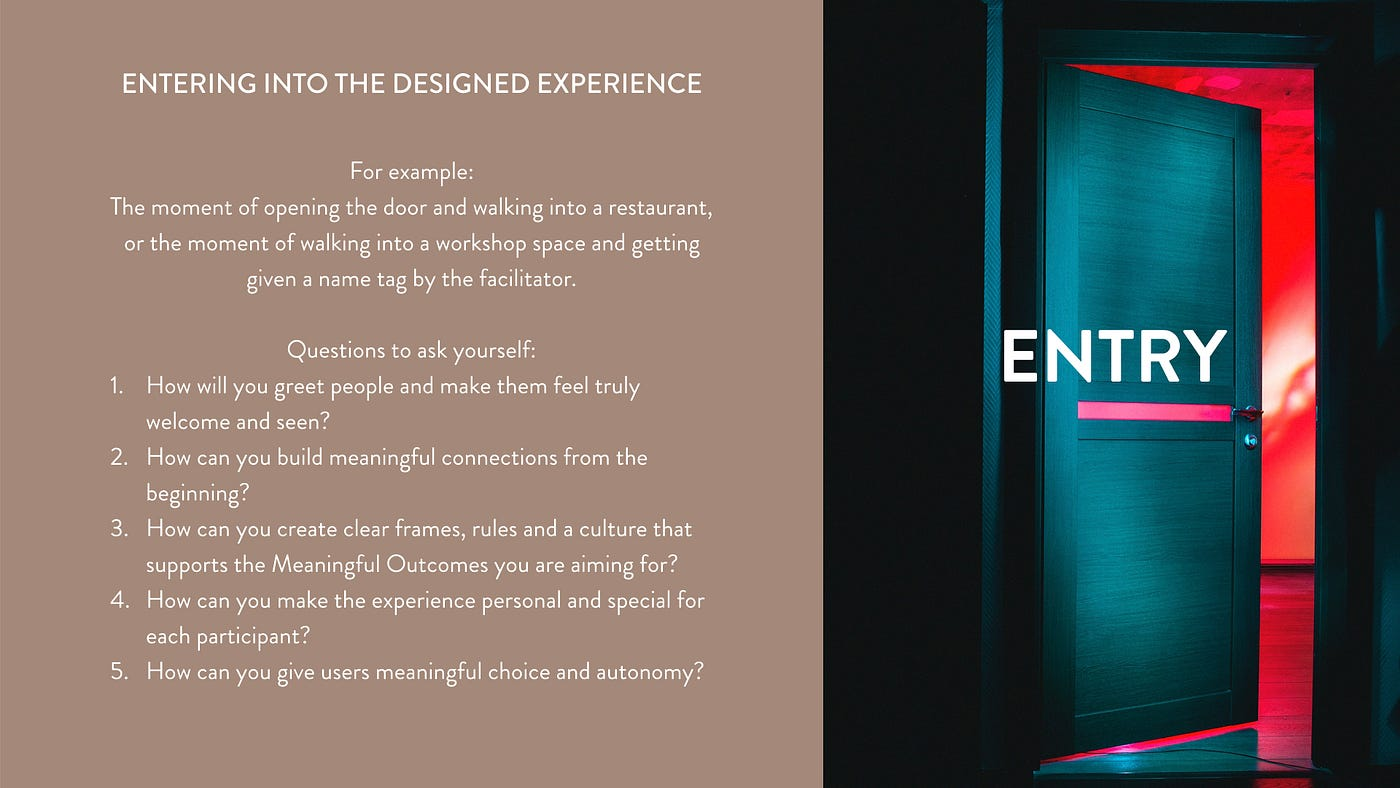
Entering into the designed experience.
For example: The moment of opening the door and walking into a restaurant, or the moment of walking into a workshop space and being given a name tag by the facilitator.
Questions to ask yourself:
- How will you greet people and make them feel truly welcome and seen?
- How can you build meaningful connections from the beginning?
- How can you create clear frames, rules and a culture that supports the Meaningful Outcomes you are aiming for?
- How can you make the experience personal and special for each participant?
- How can you give users meaningful choice and autonomy?
Engagement
The ‘main course’ of the experience.
For example: This could be being together in a workshop or watching the headlining band at a concert. It could be the skiing on a ski vacation or the time together during a Zoom virtual Christmas party.
Questions to ask yourself:
- How can you get people fully present, engaged and even into a flow state?
- How can you design a clear ‘high point’ that the experience builds up to?
- How can you design for all the levels of social interaction taking place:
a. Individual experience
b. Experiences shared with those closest/friends
c. Experiences shared by all people present
Exit
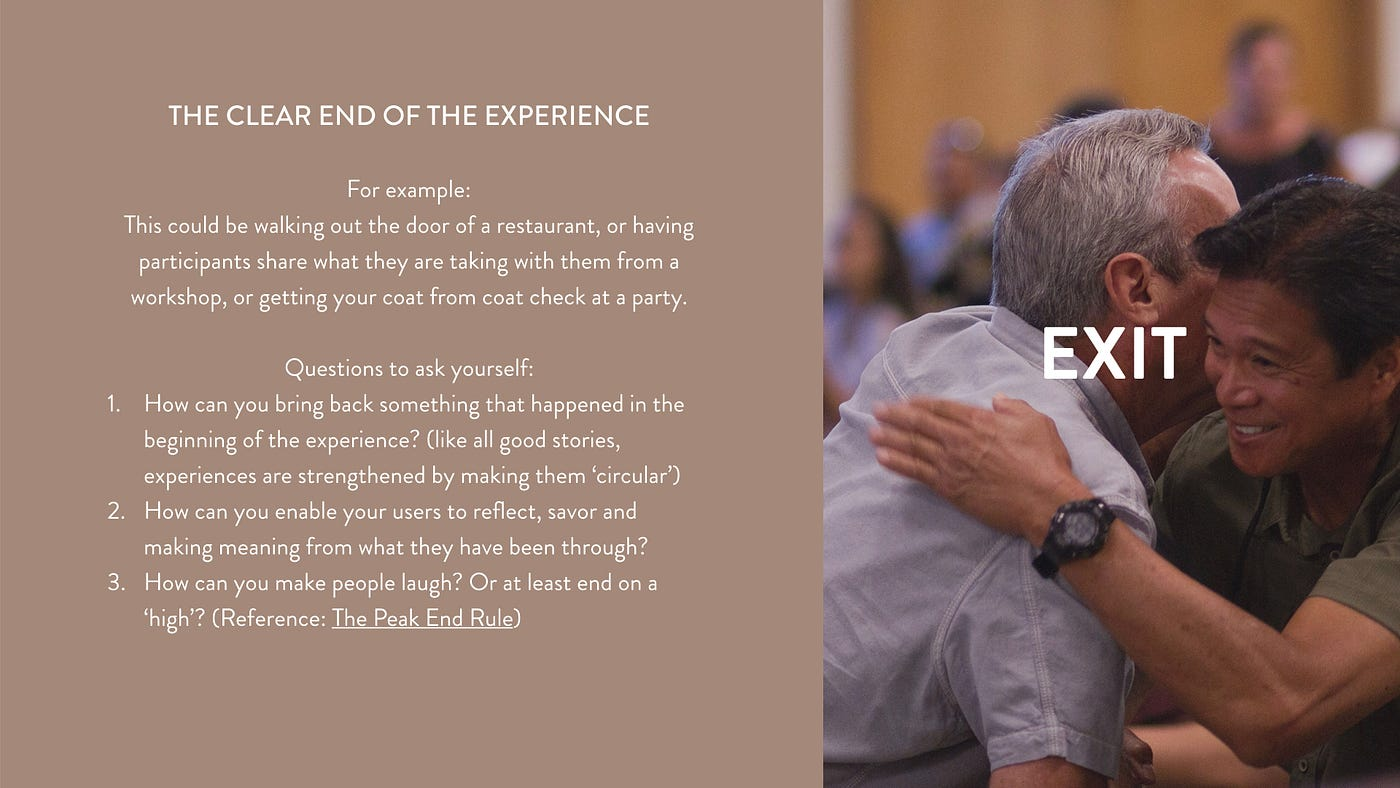
The clear end of the experience.
For example: This could be walking out the door of a restaurant, or having participants share what they are taking with them from a workshop, or getting your coat from the coat check at a party.
Questions to ask yourself:
- How can you bring back something that happened in the beginning of the experience? (Like all good stories, experiences are strengthened by making them ‘circular’.)
- How can you enable your users to reflect, savour and make meaning from what they have been through?
- How can you make people laugh? Or at least end on a ‘high’? (Reference: The Peak End Rule)
Extension
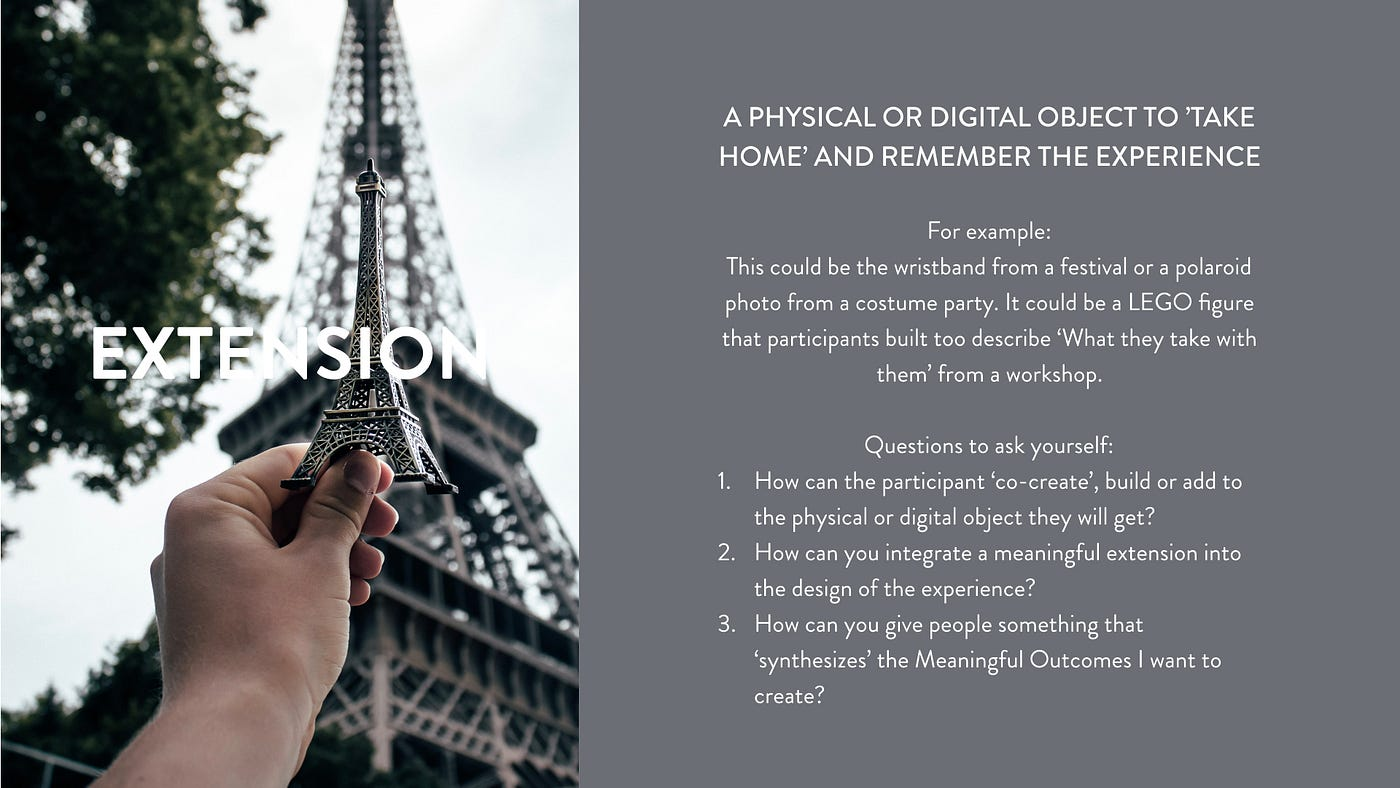
A physical or digital object to ‘take home’ and remember the experience.
For example: This could be the wristband from a festival or a Polaroid photo from a costume party. It could be a LEGO figure that participants built to describe ‘what they take with them’ from a workshop.
Questions to ask yourself:
- How can the participant ‘co-create’, build or add to the physical or digital object they will get?
- How can you integrate a meaningful extension into the design of the experience?
- How can you give people something that ‘synthesises’ the Meaningful Outcomes you want to create?
The opportunities to iterate and layer experiences are endless. The secret of getting this “right” lies in designing towards the Meaningful Outcomes, which means carefully looking at each of the 5Es in light of the experience you wish to create. Ultimately your desired outcomes will manifest through how the experience makes people feel. We are now ready to move to the next step.
“If the Meaningful Outcome is the sunshine, the emotional journey is the fertile soil from which experience grows.”
Carola Verschoor
2. Define the Emotional Journey
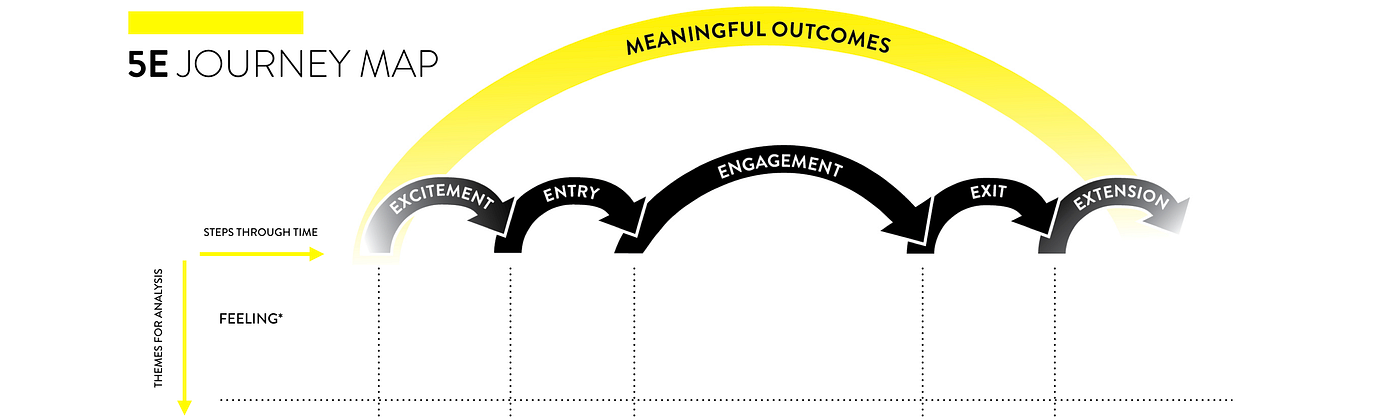
Work from left to right to fill in the ‘Feeling’ level of the 5E model.
The next step is to define the emotional journey you would like to take your users on. You want to thoroughly walk through the experience you are designing from your user’s perspective. What do you want users to feel in each stage of the experience?
Step into your users’ shoes
We suggest writing “I feel…” statements for each stage of the 5E model. Make them specific: for example, “I feel… special” is too general to help you make design decisions. But for the Entry phase of our designers’ summit in Holland, “I feel… special and seen, and relaxed with the other guests!” will guide you in designing your Entry experience. In this example, you know you need to design the Entry so that it truly makes the person feel special and seen (no small job), but also maintains the right level of informality to create a relaxed atmosphere.
Designing feelings = designing experience
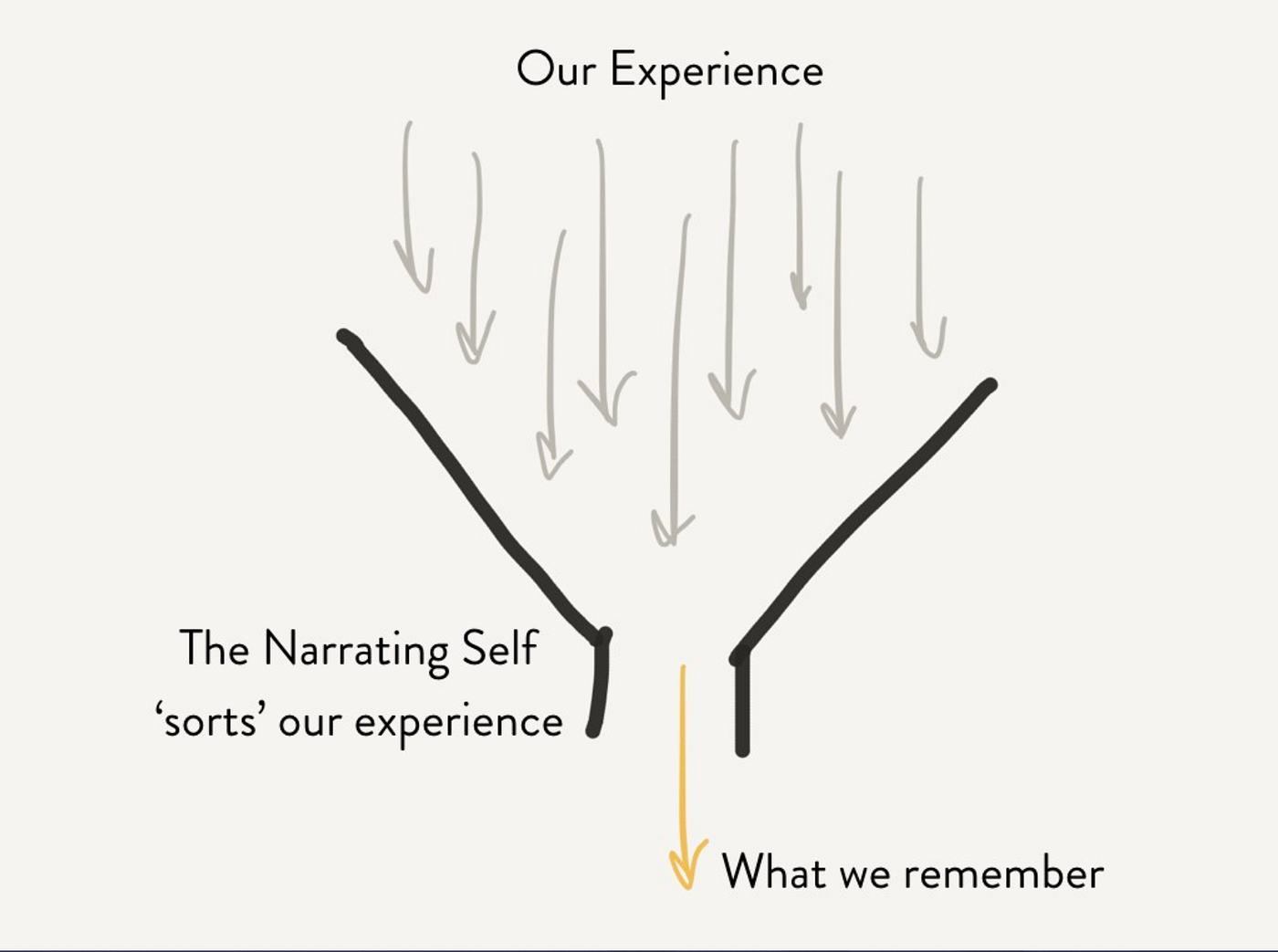
The emotions someone feels as they go through your experience will determine how and what they remember from it. The reason most design fails (and experience design is no exception) is that it is too often designed a-contextually (removed from the actual situation), whereas it needs to work in context, in real life, in real experience. And that is the domain of subjective interpretation and what Daniel Kahneman calls the Remembering Self. Our emotions edit our experiences with a sharpie and a highlighter, scratching out large parts of our experiences, and highlighting the significant, emotionally intense moments in the experience.
“Experience like breathing is a rhythm of intakings and outgivings.”
John Dewey
Take your users on a journey & keep it real
Not all emotional journeys are purely joyful. Meaningful experiences are sometimes hard. The importance of acknowledging real emotions cannot be overstated. In order to move into the creation of a meaningful experience, you often have to push people out of their comfort zone.
Seeking a meaningful outcome of ‘Community’ at our designers’ summit in Holland, we had to build a container of trust, which enabled us to navigate the sometimes messy and emotionally tense moments of defining a shared vision, where, in order for the group to agree, some people’s ideas needed to be let go. The most powerful experiences nudge users out of their comfort zone, and hold their hand as they take on issues they are afraid to tackle by themselves.
Of course, having clarity about the Meaningful Outcomes and an understanding of your users’ emotional journey is not enough. For experiences to flourish they must be well structured and organised. In our analogy of the sun and the rich soil, design is like good gardening. With the design of experiences, it is pretty much like Sir Ken Robinson famously said: “you can’t pull on grass to make it grow.” Experience design mastery is the result of tending to the ‘garden’ and iterating and improving with each season.
3. Finally, Design ‘What Happens’
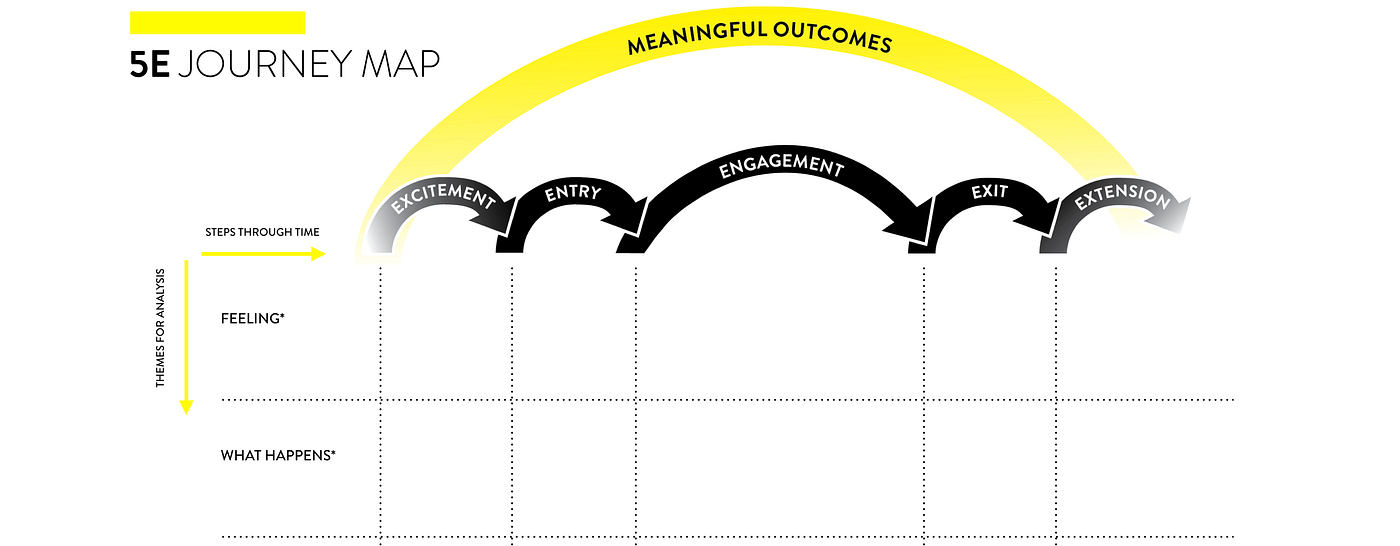
Fill in the ‘what happens’ line, making all design decisions guided by the Meaningful Outcomes and Feelings you wish to create.
From abstract to concrete, from left to right
What happens at each stage of the user’s journey? Fill in this line of the 5E template with the main activities at each stage of the user’s journey. The experience design process is a movement from abstract to concrete. Starting with Meaningful Outcomes, moving to Feelings and finally to What Happens can be challenging and feel ‘abstract’ at first, but trust the process!
For an example of “What Happens” for the Extension phase of an intensive two-hour kick-off of an online training experience, participants wrote each other a haiku on our shared WhatsApp channel (full credit for this exercise goes to Jenny Sauer-Klein and her awesome library of exercises: Play on Purpose). This was an Extension that tied together how we began the call with the shared space in between the first and the second call.
Creating a journey map: adding detail to your design
You can use the 5E model as a high-level outline of an experience, or if you are ready to take the next step as an experience designer, you can add another level of detail by customising the 5E Journey Map. The 5E model is not a template you simply fill, but a structure that you decide based on the needs of the specific experience you are designing. What additional themes for analysis are relevant for the experience you are designing?
For example, if you are designing an event with staff, you may add a layer of “Person Responsible”: who is responsible for each step of the experience? Add the layers for analysis that are relevant for the specific experience you are designing. We frequently add Challenges and Opportunities, Tasks, Storyline or Time to the 5E journey map.
Design with a learning mindset
A journey map is not a result, but a tool for planning, testing and evolving your user experience. A journey map helps you identify users’ key interactions with your workshop, event or service. Once you identify these key moments, you want to learn about them. Practically test your system of delivery: is it replicable? You also want to test whether you are on track to create the emotions you are aiming for. What is the simplest way you could test the most important moments of the experience? Have you tried it out on yourself or your friends? Let your Meaningful Outcomes guide your prototypes and co-design the experience with your team and users.
Each user is unique
Journey maps are flawed in that they inherently assume a one-size-fits-all model for designing. Each user is their own unique universe of strengths, challenges and meaning making, and will have entirely different needs and desires. However, it does give you the ability to have a greater level of ‘control’ in empathising with the emotional journey you want to create and identifying the moments that matter most to your users.
This third step brings us to the end of our exploration of the 5E model. Once you start using it, it becomes second nature and you will see examples of it everywhere in your own life. To be a master experience designer requires you to work deeply with emotions and reverse engineer where meaningful moments come from, but also to have a learning mindset, and iterate and improve your experiences with each round.
So let’s zoom out and look at how to use this tool:
- You can simply sketch it by hand and fill it in with post-its
- 👉 Use our free 5E Experience Design template in Miro 👈
Or use the image below: take a screenshot and drag it into your favourite design program (Canva, PowerPoint…):
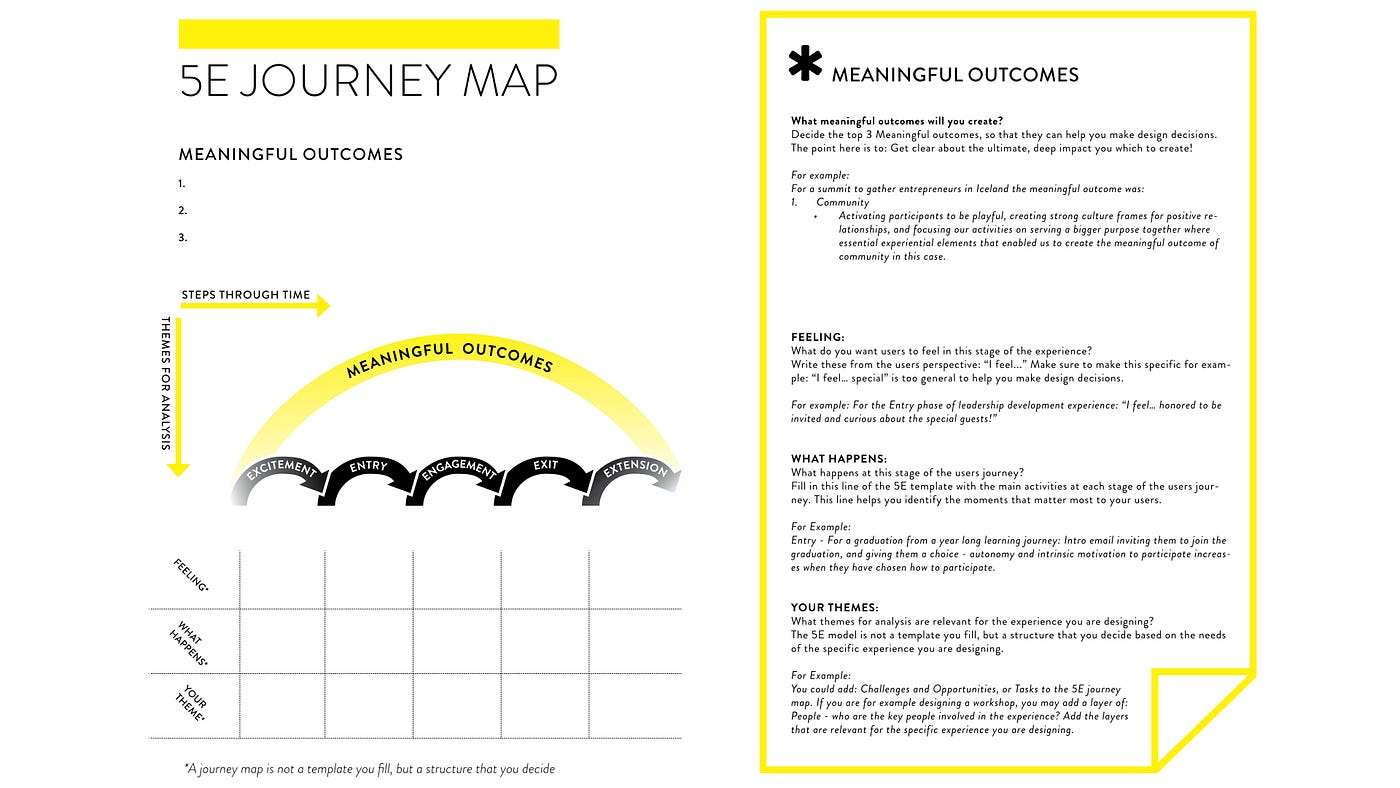
You can simply sketch your 5E on a big piece of paper using post-its!
This tool is truly versatile. We hope that you apply it to your professional work, and also to your personal life. We’d love to hear about the experiences you are designing!
HUGE thank you to Carola Verschoor, who has been invaluable in the rewriting of this piece 🙏
A note on the name: the 5E Experience Design Model is not Roger Bybee’s 5E Instructional Model (Engage, Explore, Explain, Elaborate, Evaluate), a lesson-planning model from science education.
Want to learn more about experience design?
I offer trainings and talks for organisations like IKEA, adidas, LEGO, Oxfam and the UN, as well as supporting many startups in developing their experience strategy. Would love to connect.
“I can honestly say this has been one of the most impactful trainings I have ever experienced. I was not only learning with my mind but felt what I was learning throughout. There was so much attention to detail and moments of surprise.”
Lena Sievers, Cultural Transformation Manager
Make your experiences stick
Sign up for an occasional letter and to be the first to know when we release new research.